No surprises, start to finish
What Happens on an IV Visit
This page describes what actually happens when a nurse comes to your address in Lakewood. It is written so you can decide whether this is the right service before you call, and so you know what to expect if you do.
Before anything starts
Your nurse reviews your health history before any treatment begins — what is going on now, what you have been able to keep down, any conditions, and any medications you take.
Your vital signs are checked on arrival, before the line goes in.
If what you describe does not sound like something that should be treated in a living room, you will be told that, and the visit will not go ahead. That is the point of doing the assessment first rather than after.
Who arrives
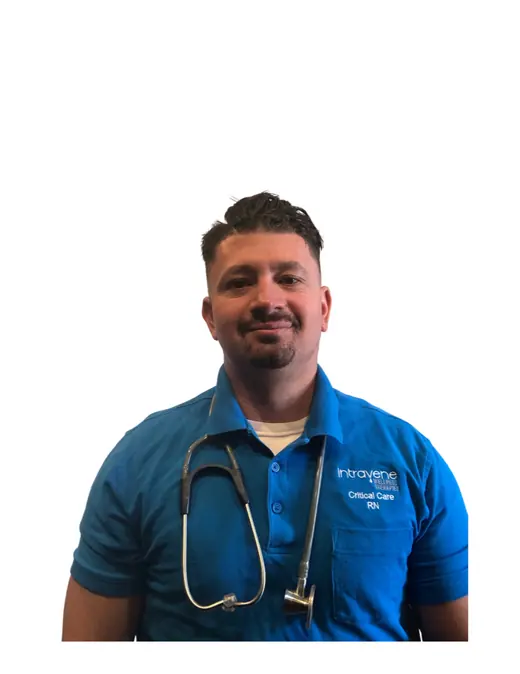
Every Intravene visit is carried out by a critical-care nurse — ICU- or ER-trained.
That is a deliberate staffing choice and it is the main thing that separates this from a walk-in wellness bar. These are clinicians whose day job is placing and managing IV lines on people who are genuinely unwell, and whose training is in noticing when something is going wrong rather than when a session is running long.
You will be told who is coming. If you want to confirm a Colorado licence before you book, you can — practitioner licences are public record through the Colorado Division of Professions and Occupations.
Medical oversight
Intravene operates under independent medical oversight from Guardian Medical Direction, a national physician-led medical direction group. Guardian provides medical oversight to medical spas, wellness centers, telemedicine companies, and healthcare practitioners across the country. Through its team of highly qualified medical directors and physician collaborators, Guardian's mission is to provide high-quality medical oversight to practitioners striving to increase access to healthcare and better the lives of their clients and patients.
To be precise about what that does and does not cover: Guardian's oversight governs how Intravene delivers care. It is not a review or endorsement of the content on this website. Those are separate things and we do not present them as one.
What is in the bag, and where it comes from
Your nurse discusses what you actually need before mixing anything, and prepares it on site rather than arriving with something pre-selected for you.
Everything we use is a commercially manufactured pharmaceutical product. Nothing is compounded — we do not use custom preparations made up by a compounding pharmacy, and there is no proprietary blend whose contents we will not tell you.
That distinction matters more than it sounds. Compounded sterile products are prepared outside a manufacturer's quality system, and it is the area where regulators have found the most problems in this industry. Asking a provider whether their ingredients are manufactured or compounded — and if compounded, by which pharmacy, and whether it is licensed — is one of the more useful questions you can ask. We think you should ask it of anyone, including us.
Supplies are single-use. Your nurse opens them in front of you.
What is actually in your drip is discussed before it goes up, by name. If you want to see the packaging, ask — it is in the bag your nurse arrived with.
During the visit
Most treatments run 30 to 60 minutes. Your nurse stays with you for the whole of it — they do not set the line and leave.
You can sit wherever you are comfortable. Most people are on a sofa or a bed. There is no clinic, no waiting room, and nothing to drive home from afterwards.
Before your nurse leaves
Your vital signs are checked a second time, after treatment, before your nurse packs up.
We mention this specifically because it is not standard across this industry. A great many providers describe monitoring during a session; far fewer close the loop at the end of it. Checking afterwards is how you find out whether the session did what it was supposed to do, and it is how a clinician catches the small number of problems that show up late rather than early.
What we decline
We do not take every booking, and it is better to say so here than on the phone.
Your nurse will decline and direct you elsewhere if what you describe belongs in an emergency department: fainting or near-fainting, confusion, severe or worsening abdominal pain, chest pain, difficulty breathing, blood in vomit or stool, a stiff neck with fever, or signs of severe dehydration such as not passing urine for many hours.
Being pregnant, elderly, immunocompromised, or living with significant heart or kidney disease does not automatically rule out a visit, but it does change the assessment, and in some cases the answer will be that you should be seen somewhere with more behind it than a nurse and a bag of fluid.
We would rather lose the booking than take one we should not have.
What we do not carry
We are a mobile IV service, not an emergency service, and the honest version of that is a list of things we do not have with us.
We do not carry supplemental oxygen. We cannot run laboratory tests or imaging, so we cannot tell you what is causing your symptoms — only treat dehydration where dehydration is the problem. We do not carry what an ambulance carries.
If any of those is what you actually need, the right call is 911 or an emergency department, and we will say so.
Frequently asked questions
Do you check vital signs?
Yes — on arrival before treatment begins, and again at the end of the visit before your nurse leaves.
Who will be coming to my home?
A critical-care nurse, ICU- or ER-trained. You will be told who before the visit, and Colorado practitioner licences can be verified publicly through the Division of Professions and Occupations.
How long does a visit take?
Most treatments take 30 to 60 minutes, plus a short assessment at the start and the vitals check at the end.
What if you decide I should not have the treatment?
Then you are not charged for a treatment you did not have, and your nurse will tell you plainly where you should go instead. That conversation is part of the visit, not an upsell.
Is this covered by insurance?
No. This is an elective service, paid directly, and it is not emergency medical care.
Speak to someone now
If you have read this far and it sounds like what you need, this is the number.